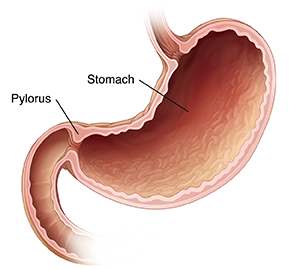
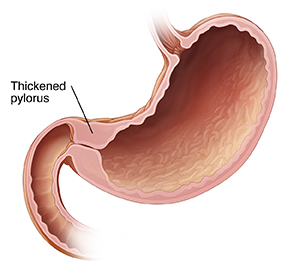
The pylorus is the valve between the end of the stomach and the start of the small intestine. The pylorus opens to let food out of the stomach and into the small intestine. Then it closes. If the muscle around the pylorus thickens, the pylorus can’t open all the way. In children, this problem is called infantile hypertrophic pyloric stenosis. Food can’t leave the stomach to be digested and absorbed in the intestine. This means the body can’t absorb nutrients, and this can lead to malnutrition. And it can’t absorb fluids either, leading to fluid loss (dehydration). Infantile pyloric stenosis can happen when a baby is 1 to 2 months old. Experts are not sure what causes it. But it seems to run in families. It is more commonly seen in boys than girls.
What are the symptoms of infantile hypertrophic pyloric stenosis?
A child with pyloric stenosis may have:
-
Vomiting, often forceful (projectile vomiting).
-
Hunger right after vomiting.
-
Loss of weight or poor growth despite having a good appetite.
-
Signs of dehydration such as less urine, very dark urine, dry mouth, and no tears when crying.
-
A lot of stomach movements after feeding.
-
Few or no bowel movements.
How is infantile hypertrophic pyloric stenosis diagnosed?
During a physical exam, the health care provider may be able to feel a lump of thickened muscle through the belly (abdominal) wall. Your child may need tests such as:
-
Abdominal ultrasound. Sound waves are used to create an image of the inside of the abdomen and the pylorus.
-
Upper GI (gastrointestinal) X-ray. The baby takes a liquid called contrast that lights up on an X-ray. An X-ray image is taken of the stomach and top of the small intestine, which shows the pylorus. Only a very small amount of contrast gets out of the stomach. This test may be done if the lump can't be felt or the ultrasound isn't clear.
How is infantile hypertrophic pyloric stenosis treated?
Pyloric stenosis is treated with a surgery called pyloromyotomy. The surgery may be done with several small incisions (laparoscopic surgery). Or it may be done with one larger incision (open surgery).
If your child is dehydrated, this must be treated before surgery can be done. Fluids are given through an IV (intravenous) line. These replace the fluids your child’s body has not been able to absorb from feeding. Blood tests may also be done to check for problems that dehydration may cause.
During surgery, the thickened muscle is cut. The stomach contents can then flow into the intestine. In most cases, your child can start eating again about 3 to 4 hours after surgery. Your child can go home about
Your baby will have follow-up visits with the pediatric surgeon. This is to make sure your baby is eating well and gaining weight, and that the surgical incisions are healing.
What are the long-term concerns?
After treatment, most children don’t have long-term problems. In the short term, your child may still have some vomiting or reflux. Reflux is a small amount of liquid coming up from the stomach into the mouth. This is normal for a short time after surgery. It should go away as your child heals. Even after surgery, there is a small chance the muscle around the pylorus will thicken again.
When to call the doctor after surgery
After surgery, call the health care provider if your child:
-
Has vomiting that won’t stop or looks green.
-
Cries and can’t be soothed. This can mean your child is in severe pain.
-
Loses weight or has no weight gain.
-
Has no bowel movement within
2 to 3 days after surgery. -
Shows signs of dehydration such as less urine, very dark urine, dry mouth, and no tears when crying.
-
Shows low energy.
-
Has a fever of
100.4 ºF (38.0 °C) or higher, or as advised by the provider.
Featured in
Online Medical Reviewer: Daphne Pierce-Smith RN MSN
Online Medical Reviewer: Marianne Fraser MSN RN
Online Medical Reviewer: Vinita Wadhawan Researcher
Date Last Reviewed: 03/01/2025
© 2000-2026 The StayWell Company, LLC. All rights reserved. This information is not intended as a substitute for professional medical care. Always follow your healthcare professional's instructions.


Related Articles
Pyloric Stenosis
Pyloric stenosis is narrowing of the pylorus. This can block the passage of food out of the stomach. The problem is often first seen in young infants.
Pyloric Stenosis
Pyloric stenosis is a problem that causes forceful vomiting. It affects babies from birth to 6 months of age. It can lead to dehydration. This condition is the second most common reason why newborns have surgery.
After Your Child's Surgery for Pyloric Stenosis
Pyloric stenosis is a condition that makes it hard for food to move from the stomach into the small intestine. The treatment is surgery called pyloromyotomy. Here's what you need to know about home care following the surgery.
Your Baby's Pyloric Stenosis Repair: Before Surgery
Watch this video to learn what to expect when a baby has surgery to repair pyloric stenosis.