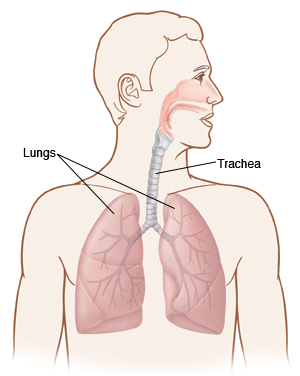
Hemoptysis is the medical term for coughing up blood. Many things, including minor illnesses like bronchitis, can cause it. It can also be an early sign of a more serious illness, like a blood clot in the lung (pulmonary embolism), cancer, tuberculosis, or pneumonia.
Less common causes of hemoptysis can be hard to diagnose in an emergency room or a clinic. More testing will be needed if the symptoms continue.
Home care
-
Stay away from cigarette smoke. Smoke irritates the bronchial passages.
-
Unless you are taking daily aspirin to prevent stroke or heart attack, don't take aspirin or products that contain aspirin. Check with your health care provider to see if you should continue the aspirin or when you should restart it if you develop hemoptysis. Aspirin affects how easily the blood clots. Medicines that prevent clotting may make hemoptysis worse.
-
If you have a lung infection, drink extra fluid. This will help loosen lung secretions.
-
Over-the-counter (OTC) cough medicines that contain dextromethorphan may help reduce coughing. Note: Check with your provider before taking dextromethorphan or other OTC medicines if you have a chronic illness, are pregnant, or take daily prescribed medicines.
-
If you were prescribed an antibiotic, take it until it's all gone. Take it even if you're feeling better after only a few days.
Follow-up care
Follow up with your health care provider, or as advised.
When to call your doctor
Contact your health care provider right away if you have:
-
A fever of 100.4ºF (38ºC) or higher, or as advised by your provider
Call 911
Call
-
You cough up more blood.
-
You have trouble breathing, wheezing, or pain with breathing.
-
You have chest pain or chest pressure.
-
You faint or lose consciousness.
-
You have a fast heartbeat.
-
You feel weak or dizzy.
-
You have a feeling of doom.
Online Medical Reviewer: Chris Southard RN
Online Medical Reviewer: David A Kaufman MD
Online Medical Reviewer: Marianne Fraser MSN RN
Date Last Reviewed: 01/01/2025
© 2000-2026 The StayWell Company, LLC. All rights reserved. This information is not intended as a substitute for professional medical care. Always follow your healthcare professional's instructions.

Related Articles
Nosebleed (Adult)
Most nosebleeds happen because of dry air or because of nose-picking. They can occur during a common cold or an allergy attack. Most aren't serious but sometimes you need to see a health care provider.
Lower Gastrointestinal (GI) Bleeding (Stable)
The appearance of blood in the stool depends on where in the gastrointestinal tract the bleeding is coming from. Blood from the lower part of the GI tract is usually bright red.
Hemodialysis Access Bleeding
You have a hemodialysis access in your arm, either an arteriovenous (AV) fistula or an artery to vein graft. It has been bleeding. Blood needs to flow freely through the fistula or graft. As part of your treatment, you are also taking medication that thins your blood. This makes you bleed more easily. It is important to stop your fistula or graft from bleeding as soon as possible.
Nosebleed
Read on to learn how to treat a nosebleed at home, and when you should get medical care.