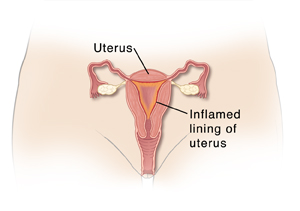
You have endometritis. This means the lining of the uterus is inflamed. It's usually caused by an infection.
Common symptoms of endometritis are:
-
Fever.
-
Feeling ill.
-
Pain in the lower belly (abdomen).
-
Abnormal bleeding from the vagina.
-
Bad-smelling fluid from the vagina.
-
Pain when urinating.
-
Pain during sex.
-
Headache.
-
Fatigue.
-
Loss of appetite.
Endometritis can be caused by:
-
Vaginal delivery or C-section.
-
Long labor.
-
Miscarriage.
-
Abortion.
-
Tissue from the placenta that stays in the uterus after delivery.
-
Vaginal infection.
In some cases, an infection called pelvic inflammatory disease (PID) also happens. This affects the ovaries and fallopian tubes. If not treated, PID may lead to infertility. It can also lead to full-body infection (sepsis).
Home care
You may be given antibiotics to take for the infection. Your symptoms should get better within 2 to 3 days of starting the antibiotics. Take the antibiotics until they are used up. It’s important to finish the antibiotics even if you feel better. This is to make sure the infection has cleared up.
General care
You can take acetaminophen or ibuprofen for pain, unless you were given a different pain medicine to use. If you have chronic liver or kidney disease, talk with your health care provider before using these medicines. Also talk with your provider if you’ve had a stomach ulcer or digestive bleeding or are taking blood thinner medicine.
-
Plan to rest at home for the rest of the day.
-
Until you have taken all the antibiotics and your symptoms are gone:
-
Don’t have sex until your provider says it's okay.
-
Don’t put anything into your vagina, including tampons.
-
Don’t douche. Douching is generally not recommended at any time.
-
Don’t take a tub bath, use a hot tub, or swim. It’s fine to shower.
-
Follow-up care
Follow up with your health care provider, or as advised. You may need to have a procedure to clear tissue out of the uterus. This is called dilation and curettage (D&C). Your provider can tell you more about this.
Call 911
Call
-
Severe pain and very heavy bleeding
-
Severe lightheadedness, passing out, or fainting
-
Rapid heart rate
-
Trouble breathing
-
Confusion or difficulty waking up
When to get medical advice
Call your health care provider right away if any of these occur:
-
Fever of 100.4°F (38°C) or higher, or as directed by your provider
-
Symptoms get worse
-
You have new symptoms
-
Nausea or vomiting
-
Your symptoms don’t improve within 3 days of starting treatment
Featured in
Online Medical Reviewer: Daphne Pierce-Smith RN MSN
Online Medical Reviewer: Tennille Dozier RN BSN RDMS
Online Medical Reviewer: Vinita Wadhawan Researcher
Date Last Reviewed: 02/01/2025
© 2000-2026 The StayWell Company, LLC. All rights reserved. This information is not intended as a substitute for professional medical care. Always follow your healthcare professional's instructions.

Related Articles
Nonobstetric Endometritis
Here's what you need to know about treatment and home care for nonobstetric endometritis.
Endometriosis
The tissue that lines the uterus is called the endometrium. Normally, if a woman doesn’t get pregnant, this tissue is shed each month during her period. In endometriosis, tissue that looks and acts like endometrial tissue implants outside the uterus.This can cause pain, heavy periods, and infertility.
Endometriosis
Endometriosis is a condition in which tissue similar to the lining of the uterus grows in the abdominal cavity. This tissue responds to hormonal changes in the same way that the uterine lining responds. This video takes a closer look at this condition and the recommended treatments.
Endometriosis
Endometriosis is a condition that occurs when the tissue that lines the uterus begins to grow where it should not. It swells and bleeds like the normal uterine lining. This can irritate the area where the tissue is growing.