A baby (the fetus) often moves down between the pelvic bones (descend) before birth. If this is your first pregnancy, this may happen 2 to 4 weeks before labor. With repeat pregnancies, the baby may not “drop” until labor begins. The baby usually moves down headfirst. If your baby is not in a safe position for birth, or if there is a problem with the placenta, you may need special care. A cesarean section delivery may be needed.
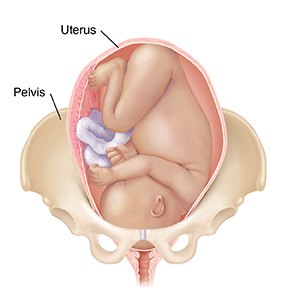
Conditions that require special care
Cephalopelvic disproportion (CPD). Baby’s head or body is too big for the pelvis.
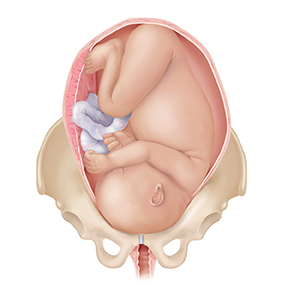
Breech position. Baby is positioned with feet or buttocks first.
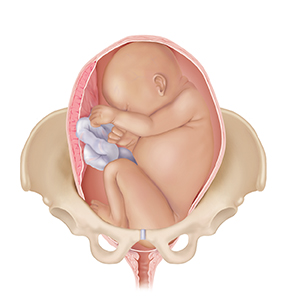
Transverse position. Baby lies horizontally across the pelvis.
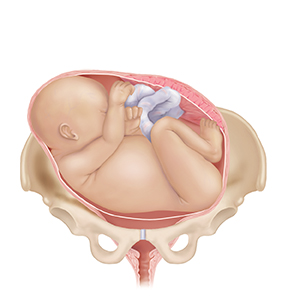
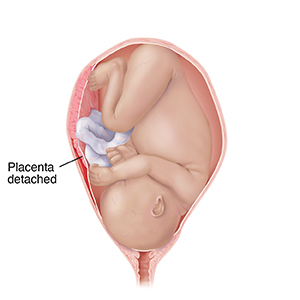
Placental abruption. Placenta separates from the uterus.
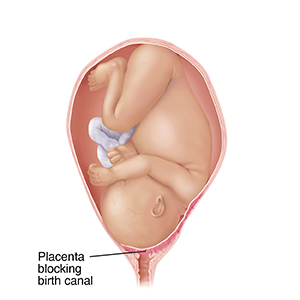
Placenta previa. Placenta blocks the cervix.
Online Medical Reviewer: Daphne Pierce-Smith RN MSN
Online Medical Reviewer: Tennille Dozier RN BSN RDMS
Online Medical Reviewer: Vinita Wadhawan Researcher
Date Last Reviewed: 06/01/2025
© 2000-2026 The StayWell Company, LLC. All rights reserved. This information is not intended as a substitute for professional medical care. Always follow your healthcare professional's instructions.

Related Articles
If Your Baby Is Breech: External Cephalic Version (ECV)
If your baby doesn't move into a head-first position on their own, your healthcare provider may attempt to do an external version. Your healthcare provider will try to rotate your baby by pressing down on your belly. Your healthcare provider may give you medicine to relax your uterus. This can make it easier for them to rotate your baby. During a version, your healthcare provider will use ultrasound to watch your baby.
Labor and Childbirth: Your Body Prepares
Learn about the physical changes that often signal that your baby will soon be born.
Breech Presentation
With breech presentation, your baby is in a buttocks-first or feet-first position. Babies are usually in a head-first position. A breech presentation can make it hard for the baby's head to fit through the birth canal during delivery. Here's what you need to know.
Delivery
During childbirth, delivery is the moment when the baby and the placenta leave your body. Delivery can be done either vaginally or by C-section.