Within the arms and legs, sheets of thick tissue called fascia separate groups of muscles. These sheets of tissue create a confined space, called a compartment. Compartment syndrome occurs when a muscle swells too much within this space. Fascia does not stretch, so it can’t expand. As the muscle swells, it's squeezed tighter and tighter. This slows or stops blood flow in the muscle. It also can injure nerve function. Long-term damage can result. In severe cases, the muscle dies. This may result in amputation.
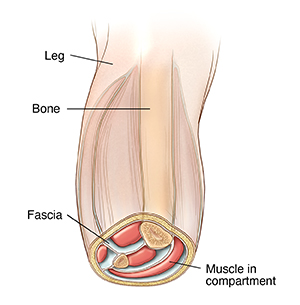
Swelling that leads to compartment syndrome is most often due to injury. This may be from an accident or other trauma, most often one with a lot of force and damage. Repeated, high-intensity exercise can also sometimes lead to compartment syndrome.
If compartment syndrome is suspected, a health care provider can measure the pressure within a compartment. A needle is put into the affected area. The needle is attached to a pressure meter. Pressure readings are then taken. If compartment pressure readings become too high, blood flow and nutrient supply to the tissue may be compromised. If your provider diagnoses compartment syndrome, emergency surgery is often needed to help relieve it before damage becomes permanent.
Due to your injury, you must watch for symptoms of compartment syndrome (see below). Compartment syndrome is a dangerous condition. It can cause death of the muscle in as little as a few hours. Call your provider and get treatment right away if you have any of the symptoms listed below.
Home care
You may be given medicines for swelling and pain. Follow all instructions for taking these medicines.
To help reduce swelling:
-
Apply an ice pack over the injured area. Do this for 20 minutes every 1 to 2 hours the first day. Continue 3 to 4 times a day until the pain and swelling subside. To make an ice pack, put ice cubes in a plastic bag that seals at the top. Wrap the bag in a clean, thin towel or cloth before using it. Never put ice or an ice pack directly on the skin.
-
Keep the affected arm or leg raised above the level of your heart. This is most vital during the first 48 hours after an injury. Place pillows under the arm or leg when sitting or lying down and at night while sleeping.
Follow-up care
Follow up with your health care provider as advised.
Call 911
Call
-
Pain that gets worse when you stretch, move, or touch the muscle.
-
Pain that does not respond to pain medicines or is getting worse.
-
Pain out of proportion to your injury.
-
Shiny, swollen, pale skin over the injury.
-
Purple foot or hand color past the level of the injury.
-
Decreased feeling in the injured limb.
-
Unusual weakness of the injured muscle.
-
Inability to move the injured muscle.
-
Numbness or tingling in the injured arm or leg that is new or gets worse.
Online Medical Reviewer: L Renee Watson MSN RN
Online Medical Reviewer: Raymond Turley Jr PA-C
Online Medical Reviewer: Thomas N Joseph MD
Date Last Reviewed: 03/01/2025
© 2000-2026 The StayWell Company, LLC. All rights reserved. This information is not intended as a substitute for professional medical care. Always follow your healthcare professional's instructions.

Related Articles
Muscle Strain in the Extremities
A muscle strain is a stretching and tearing of muscle fibers.
Crush Injury of the Hand, No Fracture
You have a crush injury of your hand. This causes local pain, swelling, and sometimes bruising. You don't have any broken bones. This injury may take from a few days to a few weeks to heal.
Hip Strain
You have a strain of the muscles around the hip joint. Learn how to care for a hip strain at home.
Shoulder Impingement Syndrome
The rotator cuff is a group of muscles and tendons that surround the shoulder joint. These muscles and tendons hold the arm in its joint. They help the shoulder turn. The rotator cuff muscles and tendons can become irritated from repeated rubbing against the shoulder bone. This is called shoulder impingement syndrome or rotator cuff tendonitis.