What is whiplash?
Whiplash is an injury to your neck. It's caused by your neck bending forcibly forward and then backward, or vice versa. The injury is not well understood. But it often affects the muscles, disks, nerves, and tendons in your neck.
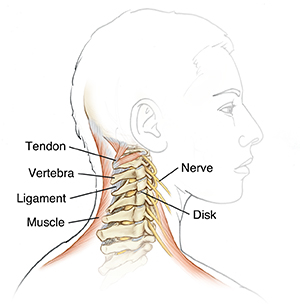
What causes whiplash?
Most whiplash injuries result from a collision that includes sudden acceleration or deceleration. Many whiplash injuries occur when you're involved in a rear-end automobile collision. They also happen as a result of a sports injury, especially during contact sports.
What are the symptoms of whiplash?
These are the most common symptoms of whiplash:
-
Neck pain
-
Neck stiffness
-
Shoulder pain
-
Low back pain
-
Dizziness
-
Pain in your arm or hand
-
Numbness in your arm or hand
-
Irritability
-
Sleeplessness
-
Tiredness
-
Trouble turning your head
These symptoms may be caused by other health problems. Always see your healthcare provider for a diagnosis.
How is whiplash diagnosed?
Along with a complete health history and physical exam, tests for whiplash may include:
-
X-ray. Electromagnetic energy beams make images of internal tissues, bones, and organs onto film. But many whiplash injuries include damage to soft tissue that can't be seen on X-rays.
-
MRI. Large magnets and a computer make detailed images of organs and soft tissue structures in your body.
-
CT scan. X-rays and computer technology make detailed images of any part of your body, including your bones, muscles, fat, and organs. CT scans are more detailed than general X-rays.
How is whiplash treated?
Treatment will depend on your symptoms, age, and general health. It will also depend on how bad the condition is.
Treatment may include:
-
Applying ice for the first 24 hours
-
Neck (cervical) collar
-
Gentle, active movement after 24 hours
-
Nonsteroidal anti-inflammatory drugs (NSAIDs), such as ibuprofen
-
Muscle relaxing medicines
-
Physical therapy
-
Osteopathic manipulation
-
Topical gels or shots into the neck to ease pain
What are possible complications of whiplash?
Most people who have a whiplash injury recover within a few weeks to a few months. Some people have persistent pain for several months or longer.
When should I call my healthcare provider?
Call your healthcare provider if:
-
Your symptoms haven't improved in the time frame your provider advised
-
Your symptoms get worse
-
You have new symptoms
Key points about whiplash
-
Whiplash is not well understood, but it often affects the muscles, disks, nerves, and tendons in your neck.
-
It's caused by the neck bending forcibly forward and then backward, or vice versa.
-
Many whiplash injuries occur if you are involved in a rear-end automobile collision.
-
Your healthcare provider will determine specific treatment for your whiplash.
Next steps
Tips to help you get the most from a visit to your healthcare provider:
-
Know the reason for your visit and what you want to happen.
-
Before your visit, write down questions you want answered.
-
Bring someone with you to help you ask questions and remember what your provider tells you.
-
At the visit, write down the name of a new diagnosis, and any new medicines, treatments, or tests. Also write down any new instructions your provider gives you.
-
Know why a new medicine or treatment is prescribed, and how it will help you. Also know what the side effects are.
-
Ask if your condition can be treated in other ways.
-
Know why a test or procedure is recommended and what the results could mean.
-
Know what to expect if you do not take the medicine or have the test or procedure.
-
If you have a follow-up appointment, write down the date, time, and purpose for that visit.
-
Know how you can contact your healthcare provider if you have questions.
Online Medical Reviewer: Daphne Pierce-Smith MSN FNP RN CCRC
Online Medical Reviewer: Joy Fincannon RN MN
Online Medical Reviewer: Kelley Gaskin RN MN
Online Medical Reviewer: Kelley GaskinLee Jenkins
Online Medical Reviewer: Louise Akin RN BSN
Online Medical Reviewer: Nancy Bowers RN MPH RN MPH
Online Medical Reviewer: Sara Foster RN MPH
Online Medical Reviewer: Lee Jenkins
Date Last Reviewed: 02/01/2024
© 2000-2026 The StayWell Company, LLC. All rights reserved. This information is not intended as a substitute for professional medical care. Always follow your healthcare professional's instructions.


Related Articles
Whiplash
When one car hits another, each person’s body is thrown toward the impact, then away from it. This is whiplash. Even at slow speeds, the force puts stress and strain on the spine, especially the neck. The weight of the head stretches and damages muscles and ligaments.
Head Injury
A head injury is a broad term that describes many injuries that occur to the scalp, skull, brain, and underlying tissue and blood vessels in the head. Head injuries are also commonly referred to as brain injury, or traumatic brain injury, depending on the extent of the head trauma.
Spinal Cord Injury
Car accidents, falls, sports injuries, and gunshot wounds cause most spinal cord damage. Electrical shock can also damage the spinal cord.
Understanding Cervical Radiculopathy
Cervical radiculopathy is irritation or inflammation of a nerve root in the neck. It causes neck pain and other symptoms that may spread into the chest or down the arm.